The aviation industry depends on far more than pilots and aircraft to keep flights operating safely and on time. For students exploring aviation careers, understanding what does a flight dispatcher do can completely change how they view the airline industry.
Behind every successful commercial flight, there is a professional monitoring routes, weather systems, fuel requirements, safety risks, and operational decisions before the aircraft even leaves the ground.
That professional is a certified “flight dispatcher”. And if you’re researching the flight dispatcher job description, you’re likely wondering: is this career worth it, what do they actually do all day, and can it lead somewhere real?
The short answer is yes, dispatchers are among the most respected non-pilot professionals in commercial aviation, with a faster path into airlines than most people realize. This guide breaks down everything you need to know before taking your first step.
The Flight Dispatcher Job Description
When students first search what does a flight dispatcher do, they usually expect a simple office coordination role. The reality is much more technical and operationally demanding.
Let’s go through the real aircraft dispatcher responsibilities inside modern airlines.
Pre-Flight Planning and Route Analysis
Before every departure, dispatchers build what’s called a dispatch release, a comprehensive operational document that covers the flight from wheels-up to touchdown. This includes:
- Selecting the most efficient routing.
- Calculating estimated flight times.
- Identifying safe alternate airports.
- Confirming airspace restrictions won’t create issues.
This isn’t a checkbox exercise. Routes can change based on jet stream positioning, military airspace activation, convective weather, or even volcanoes affecting upper-level winds. A strong dispatcher thinks several steps ahead.
Fuel Calculations and Weather Monitoring
One of the most technical parts of the flight dispatcher job description is fuel planning.
Dispatchers calculate fuel requirements using:
- Selecting the most efficient routing.
- Calculating estimated flight times.
- Identifying safe alternate airports.
- Confirming airspace restrictions won’t create issues.
At the same time, weather monitoring never stops.
Dispatchers track:
- Convective thunderstorms
- Turbulence reports
- Wind shear alerts
- Icing conditions
- Hurricane systems
- Visibility changes
A weather system can develop quickly and completely change the operational picture within minutes.
For students asking what does a flight dispatcher do, this is one of the clearest answers: they constantly balance safety, fuel efficiency, operational timing, and weather risk simultaneously.
PRO TIP:
If you’re drawn to meteorology or have always found weather systems fascinating, dispatch is one of the few aviation careers where that interest becomes a genuine professional skill used every single day.
Live Flight Monitoring
Once the aircraft is airborne, an airline flight dispatcher transitions into active monitoring mode. Modern airline operations software gives dispatchers a live picture of every flight they’re responsible for: position, altitude, fuel consumption, route deviations, and arrival estimates.
If a flight encounters unexpected headwinds and fuel is burning faster than planned, the dispatcher analyzes whether the original alternate is still viable or whether a closer option makes more sense. If weather rolls into the destination unexpectedly, they’re already on Aircraft Communications Addressing and Reporting System (ACARS) messaging with the crew before the pilot has finished assessing the situation.
This real-time operational control is exactly why dispatchers are classified as aviation safety professionals.
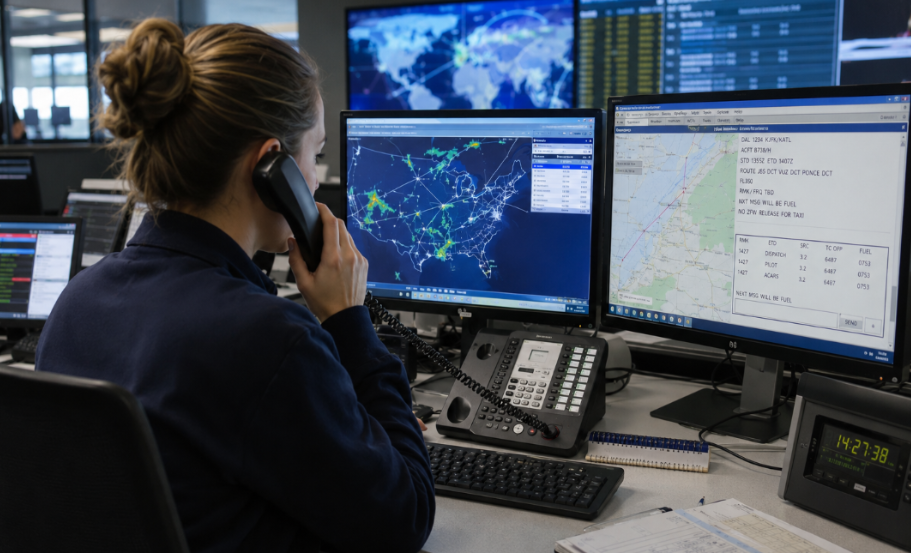
When students ask what does a flight dispatcher do after an aircraft departs, the answer is simple: the operational responsibility continues for the entire flight. Dispatchers actively monitor changing conditions and support crews with updated operational information until the aircraft safely reaches its destination.
Coordinating With Pilots, Maintenance, and Ground Teams
A busy dispatch shift involves constant communication across multiple directions at once. Dispatchers talk to flight crews via ACARS and voice, coordinate with maintenance when a technical issue might affect a departure, keep crew scheduling informed of delays, and stay connected to gate operations when turnaround times are tight.
At major airlines, a single dispatcher may be actively managing 10 to 20 flights simultaneously. The mental workload is real, and the ability to prioritize quickly is essential.
Managing Delays, Diversions, and Emergencies
This is where the flight operations dispatcher earns their title. When operations go sideways, and in aviation, they do, dispatchers are at the center of the recovery effort.
A severe weather system rolling across the Midwest can put dozens of flights in flux at the same time. An unexpected mechanical issue on the ground can cascade into crew timing violations and scheduling gaps. An in-flight emergency requires the dispatcher to instantly identify the nearest suitable airport, coordinate with Air Traffic Control (ATC), brief the crew on airport conditions, and loop in every relevant department, all simultaneously.
New dispatchers often describe this part of the job as the most stressful and the most rewarding at the same time. It’s high-pressure decision-making with consequences, and getting it right matters.
Want to break into airline operations without spending years in flight school? Get access to dispatcher-specific resume templates, oral exam prep tools, and a verified directory of hiring airlines. Create your free account today and connect with industry mentors!
What Skills Do Flight Dispatchers Need?
1. Technical aviation knowledge
The technical aviation knowledge is the foundation, and you need to understand: aviation weather systems deeply, not just read a forecast, but interpret radar, prog charts, SIGMETs, and PIREPs. Also, you need to understand aircraft performance enough to know why a hot day at a high-altitude airport changes your fuel and weight calculations. At the same time, a flight dispatcher needs to know FAA regulations well enough to make decisions confidently under pressure.
2. Critical Thinking Under Pressure
This is what separates average dispatchers from excellent ones. Conditions change rapidly in airline operations, and the ability to assess multiple variables simultaneously, identify the highest-priority issue, and act decisively is something airlines look for in every hire.
3. Communication Clarity
Communication matters more than people expect. When you’re messaging a crew about a weather deviation or coordinating a diversion with six departments at once, there’s no room for ambiguity. Clear, concise, accurate communication is a professional skill in this role.
4. Attention to Detail
This is the non-negotiable skill. Aviation has a saying: the paperwork doesn’t lie. A fuel calculation error, a missed NOTAM, or an incorrect alternate airport can turn a routine flight into a serious emergency.
5. Stress Management
The aircraft dispatcher job can be calm for long stretches and intensely demanding for short ones. Dispatchers who stay composed during disruptions are the ones who quickly build strong reputations.
FAA Flight Dispatcher Certification
To work as a certified flight dispatcher, you must complete an FAA-approved training program and pass both a written knowledge exam and an oral/practical evaluation.
FAA Aircraft Dispatcher Certificate requirements:
- Minimum age of 23 at time of certification
- Ability to read, speak, and write English fluently
- Pass the FAA Aircraft Dispatcher Knowledge Test
- Pass the FAA Aircraft Dispatcher Practical Test (oral and practical evaluation with a Designated Examiner)
According to the official Federal Aviation Administration (FAA) guidance on Aircraft Dispatcher Certification (Part 65), candidates must complete approved training courses that align with federal aviation standards before becoming eligible for certification.
Most flight dispatcher training programs cover meteorology, navigation, FAA regulations, flight planning systems, aircraft performance, and operational procedures.
Many accredited programs can be completed in 6 to 8 weeks for students who commit full-time.
IMPORTANT NOTE:
You don’t need a college degree to become a dispatcher. The FAA certification is what airlines require. That said, a background in aviation, meteorology, or logistics can give you a meaningful advantage during the hiring process.
Flight Dispatcher Salary USA: What You Can Realistically Expect in 2026
Let’s be straightforward about this, because vague salary ranges don’t help anyone make a career decision.
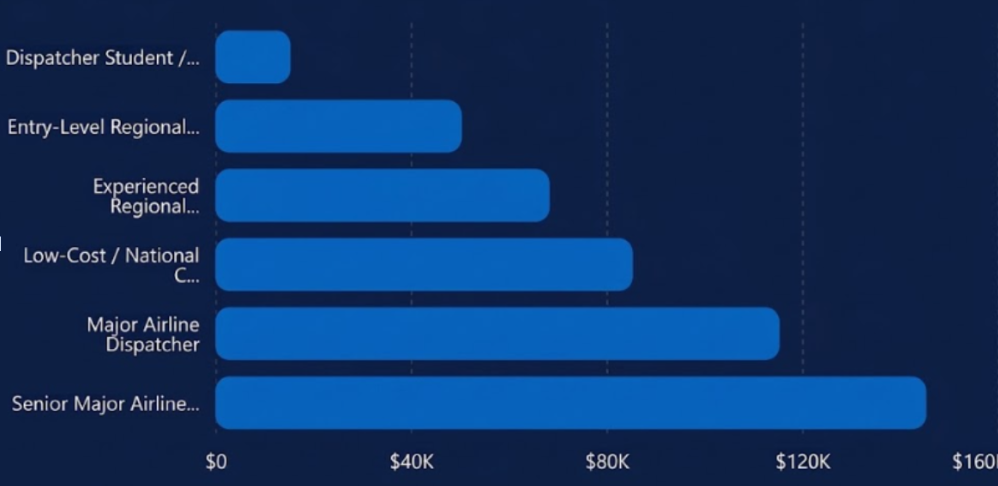
Alt Text: Flight dispatcher salary progression bar chart.
The average flight dispatcher salary in the USA across all experience levels sits around $77,000 to $80,000 annually in 2026. But that average blends wildly different stages of a career. Here’s what the progression actually looks like:
| Career Stage | Estimated 2026 Salary Range | What to Expect |
|---|---|---|
| Training Phase | $10,000–$20,000 investment | Most students pay for FAA-approved programs before entering airlines. |
| Entry-Level Regional Airline | $45,000–$65,000 | First stop for most new dispatchers; builds Part 121 experience. |
| Mid-Level Dispatcher | $70,000–$90,000 | After 2–4 years, larger operations and more complex flying. |
| Major Airline Dispatcher | $100,000–$140,000+ | Delta, United, American, Southwest, FedEx, UPS, and other top-tier employers. |
| Senior / Lead Dispatcher | $140,000–$180,000+ | Leadership, training, and management roles at major carriers. |
The reality is that regional airlines are where most dispatchers start, and the pay reflects that. Schedules can be demanding, and the salary won’t feel proportionate to the responsibility at first. Most experienced dispatchers are honest about this on industry forums; it’s a stepping stone, and treating it as one is the right mindset.
The long-term trajectory, however, is legitimately strong. Major airline dispatcher contracts include strong health benefits, paid travel privileges, retirement contributions, and shift differentials that push total compensation well above base salary figures alone.
Career Insight: Dispatchers who build 2–3 years of solid regional experience and then target a major airline opening are following the most proven path to six-figure earnings in this field. Patience and performance during the regional phase matter enormously.
Flight Dispatcher vs. Pilot: Understanding the Real Difference
This comparison comes up constantly, and it’s worth addressing clearly.
| Responsibility | Flight Dispatcher | Pilot |
|---|---|---|
| Work Location | Airline Operations Control Center | Aircraft Cockpit |
| Core Function | Flight planning and operational control | Operating the aircraft |
| FAA Certification | Required | Required |
| Weather Analysis | Extensive pre-flight and in-flight planning | In-flight situational awareness |
| Fuel Planning | Primary responsibility | Reviews and verifies |
| Emergency Response | Coordinates airline operational response | Manages direct aircraft operation |
| Training Cost | Significantly lower | Substantially higher |
| Career Entry Timeline | Months (after FAA certification) | Years (flight hours required) |
Neither path is better than the other; they’re genuinely different roles requiring different strengths. But for aviation-focused students who want to enter airline operations faster, with lower financial investment, dispatching offers a legitimate and respected route into commercial aviation.
Is Flight Dispatching a Good Career in 2026?
Yes. As more students research the flight dispatcher job description, interest in airline operations careers continues to grow across the United States.
If you genuinely enjoy aviation operations, find weather systems interesting, perform well under pressure, and can adapt to shift-based work schedules, this career has a strong long-term trajectory. The industry needs certified dispatchers, and airlines continue investing in their operations teams.
The early-career phase requires patience. Regional airline schedules and salaries test a lot of new dispatchers. But the professionals who stay with it, build their skills, and position themselves for major airline opportunities consistently describe dispatching as one of the most operationally satisfying careers in aviation.
The demand picture also looks solid. As airlines continue recovering and expanding post-pandemic, aviation dispatcher jobs at Part 121 carriers remain in steady demand. Automation is improving dispatch software, but the operational judgment that experienced dispatchers bring to disruption management isn’t something software replaces, airlines understand this.
Don’t navigate the aviation industry alone. Use an industry-specific resume builder, practice real interview scenario questions, and talk directly with working major airline dispatchers.
Where to Build Your Dispatcher Career from Day One
One thing that separates dispatchers who advance quickly from those who stall is access to the right resources, connections, and preparation, starting before they ever set foot in an OCC.
If you’re serious about entering this field, Airway Connect is the one platform built specifically around the dispatch profession. It’s not a generic aviation forum or a career aggregator; it’s a purpose-built hub for aspiring and working dispatchers, with tools that actually move the needle:
- Resume Builder: A resume builder designed around dispatcher-specific language and airline hiring standards, so you’re not submitting a generic document that gets filtered out before a human reads it.
- Interview Preparation: It is built around dispatcher-specific scenario questions and oral practical prep, developed with actual industry knowledge, not recycled career advice.
- Airline Directory: An airline directory with verified Part 121 and Part 135 carriers, filterable by state, certification type, and current hiring status, so you know exactly which doors to knock on and when.
- Professional Community: Beyond tools, Airway Connect has something harder to find: a professional community. Active forums where working dispatchers, students, and mentors exchange real advice about breaking into the industry, navigating regional contracts, and preparing for major airline transitions.
- Job Listings: Updated with direct links to official applications, so you’re not chasing outdated postings.
- Resource Library: Covering scholarships, aviation events, and internship opportunities that most people only find out about by accident.
If you’re going to invest months into dispatcher training, spend 10 minutes on Airway Connect before you commit to a program. The community and industry intelligence there will shape your decisions in ways this article can’t.
Frequently Asked Questions
How long does it take to become a flight dispatcher?
Most FAA-approved dispatcher programs take 6 to 8 weeks full-time. Including exam preparation and scheduling, most students complete certification within approximately 3 to 4 months.
Do flight dispatchers need a college degree?
No. FAA certification is the primary airline requirement. However, aviation or logistics education can strengthen hiring competitiveness.
Can flight dispatchers work remotely?
Most airline dispatch positions remain on-site inside operations control centers because real-time coordination is critical.
Are airline dispatchers in demand in 2026?
Yes. Airlines continue hiring dispatchers as operations grow and experienced professionals retire.
Is aircraft dispatch stressful?
It can be during severe weather or major disruptions. However, many dispatchers also describe the role as one of the most engaging and rewarding operational careers in aviation.
Final Thoughts
The flight dispatcher job description is more technically demanding, operationally significant, and career-viable than most people outside aviation realize. These professionals don’t just plan flights; they share legal responsibility for their safety, make real-time decisions that affect hundreds of passengers, and serve as the operational backbone of every commercial airline.
For students researching aviation dispatcher jobs, the path in is faster and more affordable than most aviation careers. The early stages require patience and commitment. But the long-term earning potential, the direct involvement in airline operations, and the genuine professional satisfaction of doing this work well make dispatching one of the most compelling non-pilot careers in commercial aviation.
Start where the professionals are. Visit Airway Connect and connect with a community that’s already navigating the career you’re building toward.