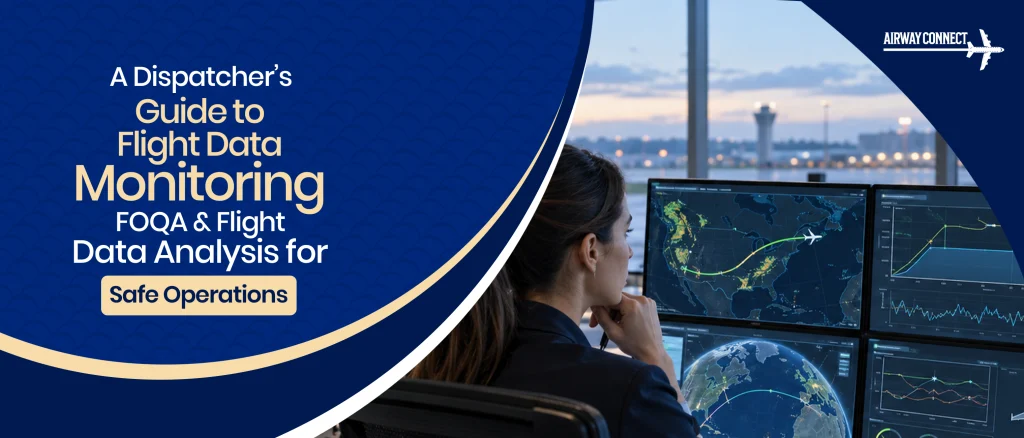
A dispatcher may never open raw recorder files during a normal shift. Flight data monitoring still affects the procedures, airport risk information, training priorities, and operational controls surrounding that dispatcher’s work.
The value comes from seeing patterns across routine flights before they become serious events. Recorded parameters can reveal repeated unstable approaches, configuration exceedances, hard landings, altitude deviations, and other operational trends.
Key Terms Explained Before We Begin
| Term | What It Means |
|---|---|
| FDM (Flight Data Monitoring) | The process of collecting and analyzing recorded aircraft flight data to identify operational trends, risks, and safety improvements. |
| FOQA (Flight Operational Quality Assurance) | A U.S. safety program that uses flight data analysis to proactively identify potential operational risks. |
| Flight Data Analysis | The examination of recorded aircraft parameters to discover patterns, events, and areas for operational improvement. |
| SMS (Safety Management System) | A structured approach used by aviation organizations to manage safety risks and improve safety performance. |
What Flight Data Monitoring Actually Means
Flight data monitoring is the routine collection and structured analysis of digital data recorded during normal aircraft operations. Airlines use the resulting patterns to identify hazards, evaluate controls, and improve operational safety.
The FAA describes FOQA as collecting and analyzing digital flight data generated during normal line operations. Its findings can support improvements in training, operating procedures, maintenance, engineering, and air-traffic procedures.
FDM, FOQA, and Flight Data Analysis Are Related Terms
In U.S. airline operations, flight operations quality assurance is the familiar FAA term for an organized program using recorded flight data. FDM is used broadly across international and industry settings.
Flight data analysis describes the analytical work inside that process: validating recorded information, identifying events, comparing frequencies, finding trends, and determining whether an operational pattern deserves deeper safety review.
The three terms overlap heavily in everyday aviation use. Their regulatory meaning and program structure can vary by jurisdiction, operator, fleet, and the safety framework governing the organization.
What Kind of Data Can Be Examined?
Available parameters depend on aircraft equipment and the operator’s program. Flight data monitoring may work with speed, altitude, vertical acceleration, heading, configuration, control inputs, engine parameters, automation states, and related values.
Those parameters become useful when they are compared with aircraft limitations, standard operating procedures, event thresholds, flight phase, airport conditions, and the operating context surrounding the flight.
Technical interviews often test whether candidates can connect weather, regulations, aircraft limitations, and procedures into one defensible decision.
How Flight Data Monitoring Moves From Aircraft to Safety Action
A mature flight data monitoring process follows a repeatable path. Data has to be collected, decoded, validated, reviewed against defined event criteria, contextualized, and converted into a safety action when required.
That sequence matters because one parameter crossing a threshold does not automatically explain why an event occurred. Analysts need enough surrounding information to understand what the aircraft and operation were doing.
Step 1: Detect Events and Exceedances
Software can compare recorded parameters with predefined event sets. An airline might track approach stability, excessive bank, flap-speed exceedances, high-energy approaches, runway events, abnormal vertical acceleration, or other fleet-specific conditions.
An event is a signal for analysis, not automatically proof of unsafe conduct. Validation determines whether the data accurately represents a meaningful operational deviation and whether the context changes its interpretation.
Step 2: Add Operational Context
Useful flight data analysis moves beyond the isolated parameter. Analysts may examine airport geometry, runway assignment, weather, aircraft type, phase of flight, procedures, recurring routes, and other relevant operational information.
A pattern of unstable approaches at one runway, for example, becomes more useful after checking winds, approach design, ATC practices, runway changes, and the conditions present when events occurred.
This same source-and-context discipline appears when a dispatcher uses a flight operations manual during live decisions. The correct response depends on knowing which information controls the situation and how separate inputs connect.
Where Flight Dispatchers Fit Into FOQA
A line dispatcher is generally not the employee running the airline’s flight operations quality assurance program. FOQA commonly sits within safety, flight operations, or a specialized analysis function.
The dispatcher’s connection appears when findings lead to changed procedures, airport advisories, operating guidance, planning considerations, safety briefings, or new controls that affect the day-of-operation environment.
Dispatchers Can Supply Context That Raw Parameters Cannot
Suppose flight data monitoring identifies repeated high-energy approaches into a particular airport. Recorded data establishes the pattern, while operational context may reveal arrival compression, runway changes, strong tailwinds, or recurrent weather conditions.
Dispatch personnel understand routing, fuel, alternates, destination weather, ATC constraints, MEL implications, and recovery options. That knowledge can help a cross-functional safety team understand conditions surrounding a recurring trend.
FOQA Is Usually Retrospective; Dispatch Monitoring Is Live
Dispatchers monitor assigned flights in real time using operational systems, weather, airport information, communications, and company procedures. FOQA normally analyzes recorded flight information after operations have occurred.
Keeping these functions separate prevents a common misconception. Flight data monitoring supports future risk reduction; the dispatcher’s immediate responsibility remains the safe planning and monitoring of flights under applicable company and regulatory procedures.
Students developing that decision-making discipline can strengthen it through realistic flight dispatcher practical exam scenarios, where weather, fuel, performance, regulations, and operational changes have to be connected quickly.

Flight Data Monitoring Inside an Airline Safety Management System
Flight data monitoring becomes more useful when its findings enter a structured safety-management process. A recurring event can be assessed as a hazard, assigned controls, monitored afterward, and compared with later data.
The FAA defines SMS as an organization-wide approach to managing safety risk and assuring that risk controls remain effective. Current Part 5 requirements emphasize hazard identification, risk assessment, controls, and safety assurance.
Data Has to Lead to a Measurable Response
Finding a trend is only the beginning. Flight operations quality assurance has value when the operator decides what should change and then checks whether that intervention actually reduced the exposure.
A response might involve revised training, an airport briefing, a procedure change, fleet guidance, maintenance investigation, or another operational control. Later data can show whether event frequency moved in the intended direction.
That feedback loop is central to useful flight data analysis:
- Detect the event or trend.
- Validate the recorded information.
- Investigate operational context.
- Assess the associated safety risk.
- Select an appropriate control.
- Implement the change.
- Monitor later data for effectiveness.
What FOQA Can Reveal That Individual Reports May Miss
One crew report can explain a specific event well. Flight data monitoring adds another perspective by showing whether the same characteristic appears repeatedly across hundreds or thousands of routine operations.
That scale is useful for finding low-frequency patterns, airport-specific concentrations, fleet differences, or gradual changes. It can also show whether a safety intervention changed the measured rate afterward.
Example: Repeated Unstable Approaches
Imagine an airline sees an elevated unstable-approach rate on one arrival. Flight data analysis might separate events by runway, wind, aircraft type, time period, approach procedure, and other useful variables.
The airline can then examine the operating environment and decide whether training, briefing material, procedure review, or another response is appropriate. Follow-up data tests whether that action worked.
Example: Turbulence and Route Exposure
Recorded aircraft response can also contribute to a broader understanding of turbulence exposure. Dispatchers already work with forecasts, pilot reports, route options, altitude changes, and fuel implications during daily operations.
Aggregated safety data can sharpen that picture over time. IATA’s Flight Data eXchange similarly uses de-identified operational data for benchmarking and identifying safety concerns across airports, regions, and aircraft categories.
Strong dispatcher preparation includes understanding operational control, safety reporting, risk assessment, and how company procedures evolve from identified hazards.
Confidentiality Matters in Flight Operations Quality Assurance
A successful flight operations quality assurance program depends on employees trusting the process. U.S. FOQA programs are designed around proactive safety learning and the use of de-identified data for broader trend analysis.
The purpose is to identify operational risk and improve the system. Program governance, data protections, labor agreements, and approved procedures determine how information is handled within a particular airline.
This matters for dispatchers too. Safety reporting works better when employees can raise operational concerns through established channels and when data is interpreted with context instead of being reduced to an isolated number.
People considering broader airline safety careers sometimes move from operations into analysis or SMS roles. Practitioners frequently discuss dispatchers and maintenance professionals describing transitions into airline safety and FOQA-related work.
What Dispatchers Should Learn From Flight Data Analysis
Dispatchers do not need to become data scientists to understand Flight data monitoring. They should understand what an event means, what contextual information matters, and how safety findings can influence operational procedures.
The useful skill is asking disciplined questions:
- What parameter or event was detected?
- Was the event validated?
- Is it isolated or part of a trend?
- Which airport, fleet, route, or flight phase is involved?
- What operational factors could explain the pattern?
- Which safety control was introduced?
- Did later data show improvement?
Candidates entering operations through ramp, crew scheduling, station control, or dispatch can see how these safety functions connect across the airline. Those paths are covered among current airport operations career options.
Flight Data Monitoring Skills That Help in Dispatcher Interviews
An airline is unlikely to expect an entry-level dispatcher to administer FOQA. Understanding flight data monitoring still shows that you recognize how modern carriers identify hazards and measure the effectiveness of safety controls.
A technical or behavioral response becomes stronger when you can separate observation from assumption. State the operational problem, identify the information required, explain the risk, and describe how you would communicate or escalate it.
That same discipline supports candidates learning how to become a flight dispatcher because certification knowledge eventually has to become practical airline judgment.
Candidates moving toward hiring can use flight dispatcher interview prep and career resources to practice explaining technical decisions, research employers, and connect certification knowledge with real operations-center expectations.
Turn Recorded Data Into Better Operational Judgment
Flight data monitoring gives airlines a structured way to learn from normal operations instead of waiting for a serious event to reveal a weakness. Its value comes from patterns, context, corrective action, and follow-up.
For dispatchers, the lesson is practical: understand how safety information reaches the operation and how procedures evolve when evidence identifies risk.
Airway Connect supports that development through technical preparation, employer research, career tools, and current dispatcher opportunities.
Frequently Asked Questions
Is Flight Data Monitoring the same as FOQA?
They describe closely related safety-data practices. In U.S. airline operations, FOQA is the established FAA terminology, while Flight Data Monitoring is widely used internationally and throughout the broader aviation industry.
Do aircraft dispatchers analyze FOQA data?
Usually, dedicated safety or FOQA personnel perform the formal analysis. Dispatchers may contribute operational context, participate in safety processes, or apply procedures and guidance that resulted from identified trends.
Does FOQA monitor pilots individually?
FOQA is structured as a proactive safety program using recorded operational data. De-identification, confidentiality procedures, program agreements, and airline governance are important parts of how approved programs handle crew-related information.
Is Flight Data Monitoring performed in real time?
Traditional FOQA/FDM analysis generally uses recorded data after a flight or data segment becomes available. Real-time airline operational monitoring uses separate dispatch, aircraft, weather, communications, and operational-control systems.
What events can Flight Data Monitoring identify?
The event set depends on aircraft parameters and operator priorities. Examples can include unstable approaches, excessive speeds, configuration exceedances, altitude deviations, high vertical acceleration, or other defined operational conditions.
How does FOQA support an airline’s SMS?
FOQA supplies objective operational data that can expose hazards and trends. SMS processes can then assess the risk, introduce controls, and use later data to determine whether those controls remain effective.