Cross-country flight planning is where weather, routing, aircraft capability, fuel, airspace, and airport conditions stop being separate study topics. A dispatcher has to connect them into one workable operating picture.
For dispatcher students, cross-country flight planning exposes weak links quickly. A route that looks simple on a map can change after winds, NOTAMs, MEL items, or alternate requirements enter the plan.
What Cross-Country Flight Planning Means for a Flight Dispatcher
In pilot training, cross-country work often centers on navigation between airports. In airline dispatch, cross-country flight planning expands into release planning, operational control, route legality, fuel, performance, and continuous monitoring.
Dispatcher planning is built around airline operating rules, company authorization, release requirements, and ongoing operational control. The current FAA dispatcher standard begins with Flight Planning/Dispatch Release for a flight between designated airports.
The standard also requires manual flight-planning knowledge in automated environments. That keeps the planning sequence important when software can produce routing, winds, fuel calculations, and release data within seconds.
VFR and IFR Planning Start From Different Operating Assumptions
VFR flight planning relies on visual meteorological conditions, terrain clearance, airspace awareness, practical checkpoints, fuel, and a route that remains usable. Company procedures still govern any airline operation conducted under VFR.
IFR flight planning adds instrument route structure, ATC filing, navigation capability, departure and arrival procedures, minimum altitudes, alternates, approach availability, weather, and company or regulatory constraints.
Part 121 contains separate dispatch or release provisions for VFR and IFR operations. Identify the operation first, then apply the appropriate weather, route, fuel, authorization, and company requirements.
Keep the Dispatch Release and ATC Flight Plan Distinct
Airline planning can involve both an operational dispatch release and an ATC flight plan. The FAA dispatcher PTS separately evaluates planning documents, routing, re-routing, and ATC flight-plan filing.
This distinction matters during cross-country flight planning because an ATC route still has to satisfy the airline’s operational requirements. Weather, fuel, performance, MEL effects, and alternates remain part of the dispatch decision.
Make route choices easier to defend during technical screening.
Practice explaining how weather, altitude, aircraft capability, fuel, and alternate decisions change when an interviewer modifies the scenario.
Start With the Mission and Aircraft Status
Strong cross-country flight planning begins with the aircraft, departure, destination, expected payload, scheduled time, and operational limitations. Route selection follows once those facts and constraints are clear.
Review aircraft status early because an MEL or CDL item can affect altitude, fuel burn, navigation capability, performance, or airport suitability. Company procedures determine how those effects enter the release.
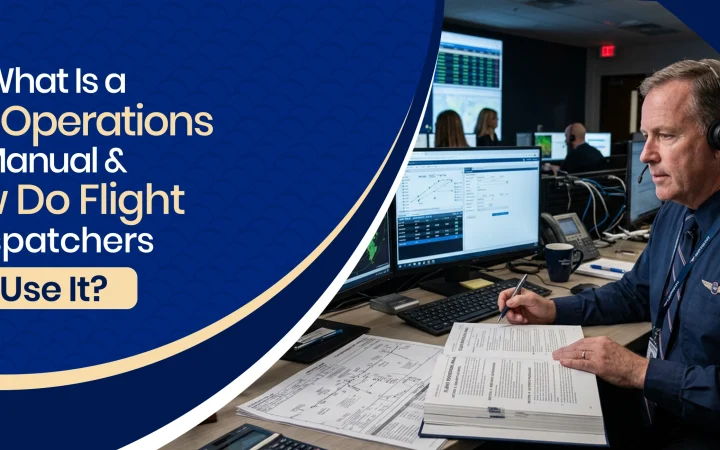
Knowing how a flight operations manual supports dispatch decisions makes route work faster when several constraints appear together. It also helps a student identify which controlled source governs each decision.
Build the Route Around What the Aircraft Can Fly
A workable route has to match aircraft capability, company authorization, navigation facilities, weather, airspace, and airport access. Cross-country flight planning therefore begins with constraints before optimization.
For IFR flight planning, review applicable SIDs, ODPs, airways, RNAV or RNP requirements, preferred routing, altitude structure, STARs, and expected approaches. Confirm that the aircraft and operation support what the route requires.
The FAA Aeronautical Information Manual preflight section currently organizes guidance around VFR and IFR plans, route changes, RNAV/RNP, departures, en-route procedures, and arrivals. That structure provides a useful route-checking sequence.
Choose VFR Checkpoints That Support Position and Diversion Decisions
Good VFR flight planning uses current sectional information to identify terrain, obstacles, special-use airspace, controlled airspace, airports, navigation aids, and visual references. Checkpoints should confirm position and progress.
Cross-country flight planning under VFR should also keep diversion options visible. A route near suitable airports, recognizable terrain, or reliable navigation aids provides more usable choices when conditions deteriorate.
The FAA Aeronautical Chart Users’ Guide has an effective date of July 9, 2026, and covers FAA chart products used for VFR and IFR navigation. Training with current editions builds useful revision discipline.
Make Weather Drive Route and Fuel Decisions
Weather belongs inside the route calculation from the first pass. Cross-country flight planning should connect winds, ceilings, visibility, convection, icing, turbulence, fronts, and airport forecasts to operational consequences.
For VFR flight planning, check whether ceilings and visibility support the intended route and whether the trend preserves diversion options. Surface winds, terrain, and lowering ceilings can reshape the plan.
For IFR flight planning, evaluate departure, en-route, destination, and alternate weather together. A usable forecast still leaves questions involving convection, icing, turbulence, runway conditions, approaches, and fuel exposure.
After reading each product, state the operational consequence. A convective hazard may require a longer route, additional trip fuel, another altitude, a different alternate, or a delayed release.

Turn Winds and Distance Into Time and Fuel
Cross-country flight planning becomes operational when route distance and forecast winds become groundspeed, time, and fuel. A stronger headwind can affect trip fuel, arrival weight, alternate margin, and payload decisions.
Build fuel from the rule set that applies to the operation. Dispatcher students should avoid importing familiar Part 91 reserve assumptions into Part 121 scenarios, where requirements vary with the applicable operation and procedures.
A useful worksheet separates taxi, trip, alternate, reserve, holding, contingency, and extra fuel when applicable. The labels can vary by carrier, while each quantity should remain traceable.
Students preparing for the flight dispatcher practical exam benefit from working these calculations manually. The FAA standard requires a manual flight plan and permits manual validation of computer-generated planning results.
Treat Alternate Planning as an Operational Branch
A useful alternate is legal, reachable, operationally suitable, and supported by enough fuel. Cross-country flight planning should test it against forecast weather, approaches, runway conditions, NOTAMs, services, and aircraft limitations.
Part 91 and Part 121 alternate requirements belong to different operating frameworks. Dispatcher students should identify the governing regulation and OpSpecs first, then apply the correct minima and operational restrictions.
A stronger alternate choice can also change the preferred route or fuel strategy. That is why cross-country flight planning works best when alternates are evaluated early enough to influence the release.
Practice complete planning scenarios instead of isolated calculations.
Keep weather, fuel, alternate selection, route structure, and reference retrieval connected so each decision has an identifiable operational reason.
Weight, Balance, and Performance Can Rewrite the Plan
Payload and fuel decisions change takeoff weight, landing weight, center of gravity, and performance margins. Cross-country flight planning therefore has to remain connected to aircraft limitations through arrival.
A runway that works at one weight may become unsuitable after a payload increase, temperature rise, contamination report, or deferred item. The response may involve payload, fuel, runway, or airport changes.
The five difficult ADX topic areas often meet here during realistic planning. Weather, performance, regulations, MEL/CDL logic, and IFR navigation become harder when one change affects several calculations.
Manual Planning Still Matters in an Automated Dispatch Environment
Modern flight-planning systems can generate routes, winds, fuel, and releases quickly. The dispatcher still has to recognize when an input, assumption, restriction, or output does not fit the operation.
The current FAA Aircraft Dispatcher Practical Test Standards identify FAA-S-8081-10E as the applicable standard. The PTS requires manual planning knowledge and a manual flight plan during the practical test.
A strong practice flight should include route selection, weather, NOTAMs, fuel, performance, alternates, weight and balance, and a release. Add one disruption afterward so the original plan requires revision.
That method also strengthens ADX knowledge because chart interpretation and regulatory recall become connected to a complete operating decision. The student sees immediately where a weak technical subject changes the flight.
A Practical Cross-Country Flight Planning Checklist
Use this checklist as a repeatable order, then adapt it to the operator’s manuals, OpSpecs, and software. Good cross-country flight planning becomes faster when the sequence remains familiar.
- Confirm aircraft, operating authority, and current status.
- Review departure, destination, alternates, and useful en-route airports.
- Build an initial route around airspace and navigation capability.
- Check current charts, procedures, NOTAMs, and airport restrictions.
- Analyze weather along the route and at required airports.
- Calculate distance, winds, groundspeed, time, and fuel.
- Verify weight, balance, takeoff, en-route, and landing performance.
- Apply MEL/CDL effects and company procedures.
- Confirm alternates and practical recovery options.
- Build or validate the dispatch release and ATC flight plan.
- Brief the PIC on controlling risks and likely changes.
- Monitor the flight and reassess when conditions move away from plan.
Common Planning Errors Dispatcher Students Should Catch Early
Cross-country flight planning weakens when a student accepts software output without checking weather, aircraft capability, procedures, or the source behind a restriction. Many planning errors begin before the arithmetic.
Watch for recurring problems such as expired charts, poor alternate choices, missed NOTAMs, reroute fuel effects, incorrect rule sets, hidden MEL consequences, and routes the aircraft cannot support.
Choosing a dispatcher school should therefore include questions about complete manual scenarios. Repeated work connecting weather, routing, fuel, performance, and regulations creates stronger preparation than isolated question-bank drills.
Build Planning Discipline That Transfers to the Dispatch Desk
Cross-country flight planning develops a repeatable habit: connect the rules, weather, route, aircraft, fuel, performance, and alternate before accepting the result. Reliable planning also leaves room for conditions to change.
Once that workflow becomes consistent, flight dispatcher career resources and jobs can connect technical preparation with airline research, interviews, and hiring opportunities. Airway Connect keeps those career steps together in one dispatcher-focused platform.
Frequently Asked Questions
What is cross-country flight planning?
It is the process of building a flight between airports by combining route, weather, time, fuel, aircraft performance, airspace, airports, alternates, and the operating requirements applicable to that flight.
What is the main difference between VFR and IFR flight planning?
VFR planning relies heavily on visual conditions, terrain, airspace, and visual navigation options. IFR planning adds instrument route structure, ATC clearance procedures, minimum altitudes, approaches, and additional alternate considerations.
Do flight dispatchers plan VFR flights?
They can support VFR operations when the carrier is authorized, and applicable operating and weather requirements are satisfied. Part 121 contains a specific provision for dispatch or release under VFR.
Is a VFR flight plan required for every cross-country flight?
No. Within the continental U.S., a VFR flight plan is not normally required. Certain operations, including flights into an ADIZ or international VFR flights, have additional requirements.
Does a VFR flight plan provide ATC separation?
A VFR flight plan primarily supports flight-service and search-and-rescue functions. ATC traffic services are handled separately, so filing a VFR plan does not create an IFR-style ATC clearance.
Why do dispatcher students still learn manual flight planning?
The FAA Aircraft Dispatcher PTS requires manual flight-planning knowledge and preparation of a manual flight plan during the practical test. Manual validation can also be used to cross-check computer-generated calculations.