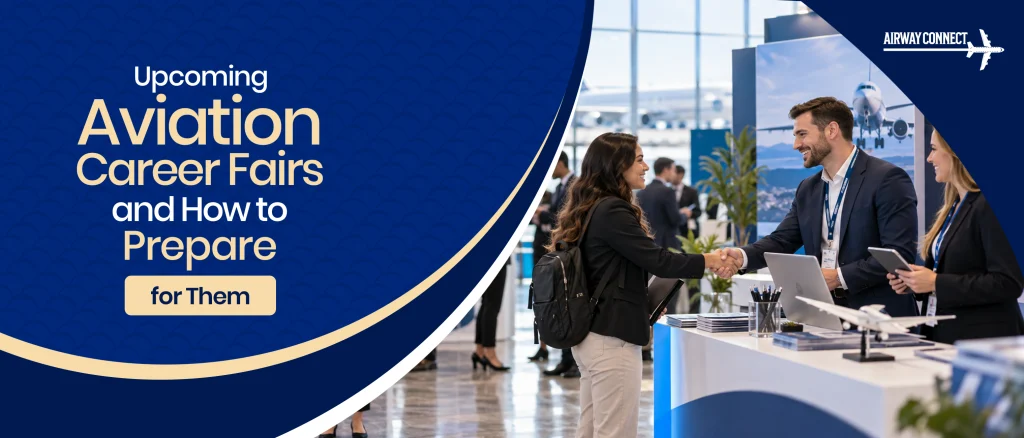
An airline recruiter may be looking for pilots, while the airport employer at the next table needs ramp staff. The most useful aviation career fairs reward candidates who know which conversation they came to have.
The upcoming months’ calendar includes public airport hiring events, university expos, and specialist conventions. Some require school affiliation. This list identifies each event’s audience and helps you prepare for a useful recruiter conversation.
Upcoming U.S. Aviation Career Fairs in 2026
The U.S. aviation event calendar changes throughout the year, and airline participation can change even after an event is announced. Always confirm registration requirements and participating employers with the organizer before booking travel.
| Date | Event and location | Access and likely focus |
|---|---|---|
| Oct. 1 | Fresno Aviation Job Fair, Fresno Yosemite International Airport, CA; 3–6 p.m. | Airport and City of Fresno event with employers in ground handling, FBO services, logistics, concessions, and airport work. |
| Oct. 1 | PTI Campus-Wide Job Fair, Greensboro, NC; 3–7 p.m. | Airport-campus employers and on-the-spot interviews; validated parking is available. |
| Oct. 1 | Embry-Riddle Prescott Fall Career EXPO, Prescott, AZ; 10 a.m.–3 p.m. | Embry-Riddle students and alumni only; broad aviation recruiting. |
| Oct. 1 | ATP Alumni Association Career Expo, Arlington, TX; 9 a.m.–2 p.m. | Register through ATP; principally a pilot-pathway event. |
| Oct. 6 | Phoenix Sky Harbor Job Fair, Phoenix, AZ; 11 a.m.–2 p.m. | Public airport hiring event; no preregistration required. Roles listed include ramp, passenger assistance, customer service, and security. |
| Oct. 6 | Embry-Riddle Daytona Beach Fall Career EXPO, Daytona Beach, FL; 8:30 a.m.–3 p.m. | Embry-Riddle students and alumni only; aviation employers include pilot and maintenance recruiters. |
| Oct. 7 | CVG Airport Campus Career Fair, Northern Kentucky; 3:30–6:30 p.m. | Free open house; no registration required. Airport-campus employers will discuss current openings. |
| Oct. 7 | Purdue Aviation Technology Career Fair, West Lafayette, IN; 10 a.m.–4 p.m. | Current and former Purdue aviation and transportation students; flight, maintenance, aviation management, and UAS. |
| Oct. 8 | K-State Salina Fall Job Fair, Salina, KS; noon–3 p.m. | Campus fair; freshmen enter at noon, with other campus students and alumni from 1 p.m. Aerospace and airline recruiters are represented. |
| Oct. 9 | Reading Aviation Career Fair, Reading Regional Airport, PA; 9 a.m.–2 p.m. | Free admission; 30-plus exhibitors and sessions on air traffic control, drones, piloting, and maintenance. |
| Oct. 13 | Auburn School of Aviation Fall Career Fair, Auburn, AL; student networking 9 a.m.–2 p.m. | University event for current aviation students; check its Handshake listing for attendance details. |
| Oct. 17–18 | RTAG National Convention, Orlando, FL; Saturday 9 a.m.–Sunday 5 p.m. | Recruiters and training organizations focused on military-to-civilian aviation transitions; check attendee registration. |
| Oct. 21–22 | NBAA-BACE Career Zone, Las Vegas, NV; Wednesday noon–5 p.m.; Thursday 9 a.m.–2 p.m. | Business aviation career fair, coaching, and networking inside the convention; check show admission. |
| Oct. 21 | Kent State Aeronautics and Engineering Fall Career Fair, Kent and Stow, OH; 10 a.m.–2 p.m. | College students and alumni; aviation, air traffic, UAS, and engineering. Pilot employers are at the airport location. |
| Oct. 23 | FAPA Pilot Job Fair, Irving, TX; 8 a.m.–noon | Free with required registration; intended for qualified pilots. |
| Oct. 29 | Middle Georgia State Aviation Career Fair, Eastman, GA; 11 a.m.–2 p.m. | MGA students and alumni; flight, aviation management, air traffic control, and maintenance. Handshake preregistration is available. |
| Oct. 29 | National Aviation Academy New England Career Fair, Concord, MA; 9 a.m.–noon | NAA students and alumni; mainly aviation maintenance recruiting. |
| Nov. 6 | SIU Aviation Management Society Fall Career Fair, Southern Illinois Airport; 9 a.m.–3 p.m. | Airline, corporate aviation, and government recruiters; aviation management is a particularly relevant pathway. |
| Nov. 6 | Aviation Education & Career Expo, Hagerstown Regional Airport, MD; time: check organizer | For students aged 16–22; scholarships and career exploration across aviation, including dispatch. Scholarship applications close Oct. 9. |
| Nov. 13–14 | AOPA Aviation Career Expo, Hyatt Regency Phoenix, AZ | Recruiting and career development across aviation roles. Admission is free for AOPA members and people 20 or younger; AOPA lists $89 for nonmembers. |
Put the event’s employers next to roles you can actually pursue, then identify the two conversations that matter most.
Choose an Event That Fits Your Next Career Move
The value of aviation career fairs depends on your target role, eligibility, and travel cost. A public airport job fair serves a different purpose from a student-only expo or a pilot convention.
Public Airport Hiring Events
Fresno, PTI, Phoenix, and CVG offer direct contact with employers working across an airport campus. Check each employer’s current vacancy before traveling, then bring a resume version that matches that operation.
PTI advertises on-the-spot interviews, while Phoenix and CVG explicitly allow attendance without preregistration. At Phoenix, an applicant seeking airline flight operations should distinguish ground-service dispatch, passenger assistance, and aircraft dispatch when reviewing titles.
University Fairs and Specialist Conventions
Campus aviation career fairs can be valuable for internships, cadet programs, and first roles, but several admit only their own students or alumni. Purdue, Embry-Riddle, Kent State, and Middle Georgia State publish such restrictions.
RTAG serves military-to-civilian transitions, FAPA focuses on pilots, and NBAA-BACE concentrates on business aviation. For wider aviation careers training, AOPA and Reading provide a broader set of conversations than a pilot-only fair.

Prepare a Short Employer List Before You Pack
Start preparing for aviation career fairs by selecting three to five employers, then open their current career pages. Record the exact role title, location, minimum qualifications, and application method for each.
Look for the person recruiting your function. An airline representative assigned to pilot programs may have little detail about system operations control, while an airport contractor may be hiring for ramp positions that day.
A brief employer sheet keeps each conversation specific. Fill it with current vacancy details before the fair, then use the questions to test where your experience fits:
| Employer | Role or pathway | Evidence you can discuss | Question worth asking |
|---|---|---|---|
| Regional airline | Dispatcher trainee or operations support, if listed | Certificate status, flight-planning exercise, shift coordination | “Which operations roles develop toward your dispatch team?” |
| Airport or ground handler | Ramp, station, passenger, or load planning | Safety checks, handoffs, disruption handling | “What would a new hire handle during a delayed departure?” |
| Maintenance employer | A&P technician or trainee | Certificate status, inspection work, shop projects | “Which fleet and shift would this opening support?” |
For a dispatcher candidate, compare live vacancies with the training path in becoming a flight dispatcher. State your certificate status accurately, as an ADX pass alone does not confer certification.
Build a Resume the Recruiter Can Use After the Event
Aviation career fairs move quickly, so the top third of your resume should identify the target role and the proof behind it. Put earned credentials, relevant systems, projects, and measurable work near the top.
If your background comes from logistics, customer support, or the military, show a real task involving prioritization, accuracy, or controlled handoffs. The aviation resume examples for beginners show how to describe transferable work accurately.
Bring several clean paper copies. Keep a digital version ready to send immediately. Recheck pilot hours, A&P status, and dispatcher credentials when your training stage changes.
Prepare one role-specific version before the first recruiter conversation. Keep a separate version for a substantially different job family.
Rehearse the Conversation That Follows Your Introduction
At aviation career fairs, a brief introduction works best when it names your role, current stage, and one relevant example. Leave room for the recruiter to describe the opening and its hiring process.
For example: “I’m completing dispatcher training and recently built a manual release exercise covering weather, fuel, and alternates. I’m interested in how your operations team trains new hires and which openings accept newly certificated applicants.”
The FAA Aircraft Dispatcher Practical Test Standards provide a reference for the technical work behind that example. Explain a decision from your exercise, its source, and the effect of changing weather.
Ask Questions That Reveal the Actual Hiring Path
Recruiters at aviation career fairs hear broad questions all day. The better question names a function, a constraint, or the next hiring step, then gives the recruiter enough context to answer.
- For dispatch: “Does this team recruit newly certificated dispatchers directly, or through operations support positions?”
- For airport operations: “Which tasks are handled by the airport authority, airline, and contractor during irregular operations?”
- For maintenance: “Which certificates, experience, and shift availability matter for the opening on your careers page?”
- For any role: “Should I apply online before or after this conversation, and which requisition number should I use?”
If a recruiter mentions a technical screening, practice explaining a decision and the source behind it. Flight dispatcher practical scenarios help you describe fuel, alternates, limitations, and the release in sequence.
Record the Next Step While the Details Are Fresh
After each conversation, write down the recruiter’s name, role title, requisition number, and any eligibility condition. A phone note is enough, a stack of brochures rarely preserves the specific instruction you received.
Follow Through While the Recruiter Remembers the Discussion
The work after aviation career fairs starts with the process the employer gave you. Within two business days, submit the required application, note its requisition number, and follow up through an offered channel.
Mention one detail from the conversation and attach the resume only if the recruiter invited it. Any candidate looking to strengthen their technical explanations should consider going through a flight operations manual to see how it supports dispatch decisions.
Keep a simple tracker with employer, contact, role, application date, and next action. That record makes it easier to compare opportunities and to keep searching airline jobs between events.
Make the Fair One Step in a Longer Job Search
The best aviation career fairs give you a clearer employer list, better questions, and a documented next action. Recheck the event page, prepare role-specific evidence, and follow the employer’s instructions.
Airway Connect brings airline research, a dispatcher-focused resume builder, interview practice, and job discovery into one place. Use these tools to turn a promising conversation into a focused application.
Frequently Asked Questions
Are aviation career fairs free to attend?
Some are free, including Reading and the FAPA pilot fair, although FAPA requires registration. AOPA publishes different admission terms by age and membership; university fairs may restrict attendance regardless of price.
Can I attend an aviation career fair without a certificate or flight hours?
Yes, when the event’s access rules allow it. Choose employers and questions that fit your current training stage, and describe unfinished qualifications honestly when discussing future applications.
Will I get hired at the fair itself?
An interview can happen at some events; PTI expressly advertises on-the-spot interviews. Most candidates should still expect an employer application and screening process, so ask for the exact next step.
What should I bring to an aviation job fair?
Bring a targeted resume, a digital copy, registration or student identification when required, and notes on the employers you selected. Pilots can keep accurate flight-time details available; dispatchers should know their certificate status.
What should I wear to an aviation career fair?
Wear clean, business-appropriate clothes that let you walk the venue comfortably, and check whether the organizer specifies attire. At an event advertising on-the-spot interviews, arrive ready for a formal conversation.
How do I find out whether an airline is hiring aircraft dispatchers?
Check the airline’s live careers page for aircraft dispatcher, flight dispatcher, or operations-control openings before visiting its booth. Ask whether the representative recruits that function and which requisition accepts applications.
Are university aviation career expos open to the public?
Access varies by organizer. The Embry-Riddle expos are limited to its students and alumni, while Purdue and Kent State also state their own student or alumni eligibility rules.